
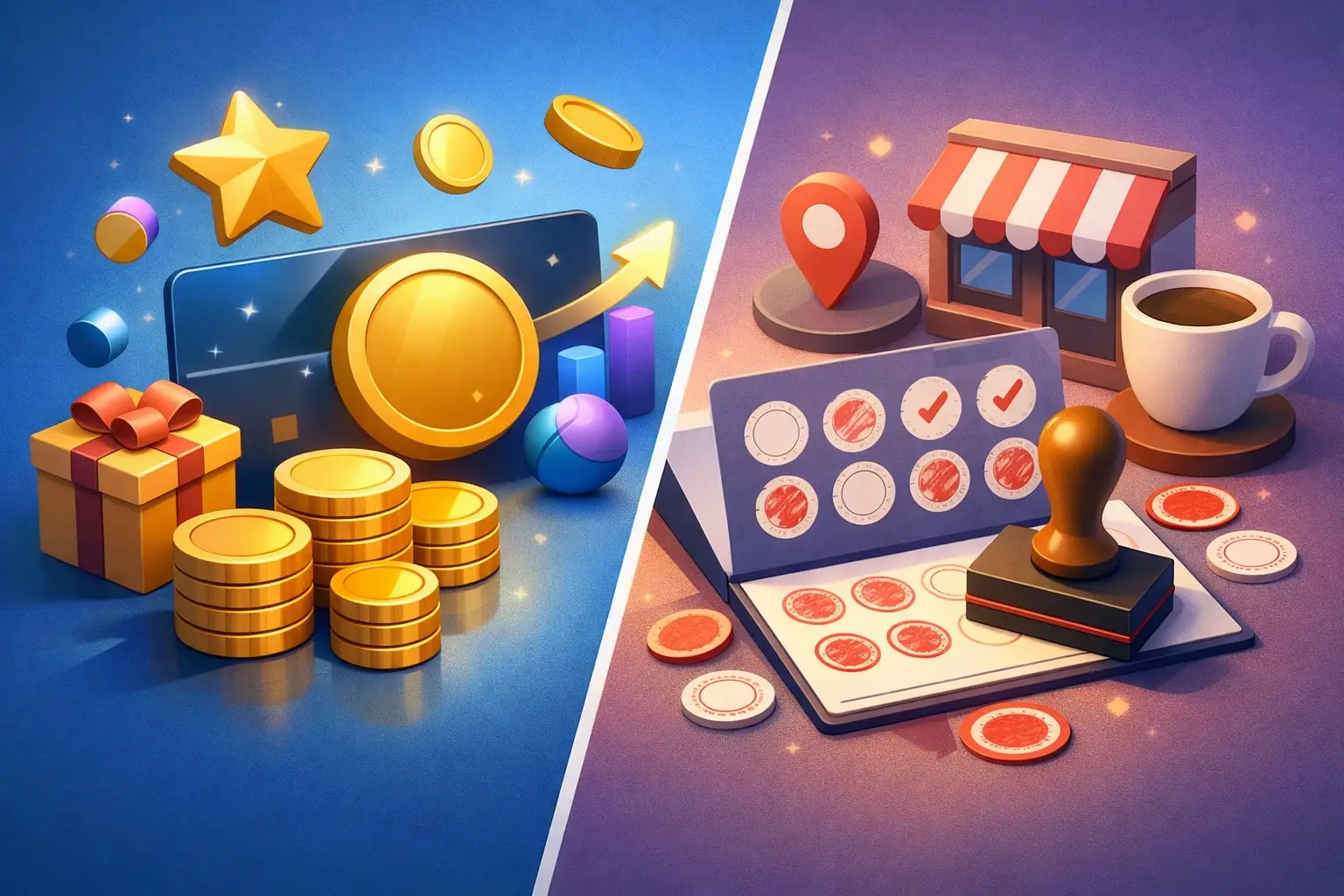
A customer buys their usual coffee, has a quick haircut or picks up lunch on the way back to work. You want that ordinary visit to become the next one too. That is where points rewards versus visit stamps becomes a practical business decision, not just a choice of card design.
Both approaches can encourage repeat custom. Both give customers a reason to come back rather than try the competitor down the road. But they create different habits, suit different purchase patterns and require different levels of explanation. The best scheme is usually the one customers understand in seconds and your team can run consistently during a busy shift.
What is the difference between points rewards and visit stamps?
A visit stamp scheme rewards a customer for showing up and making a qualifying purchase. Buy nine coffees, receive the tenth free. Book five nail appointments, get money off the sixth. It is familiar, visual and easy to explain at the till.
Points rewards give customers a value based on what they spend or what they buy. For example, a customer might earn one point for every £1 spent, then exchange 100 points for a reward. You can also award different point values for selected products, quieter days or higher-value services.
The difference sounds small, but it changes the behaviour you are encouraging. Stamps say, “Come back again.” Points can say, “Spend more, try this product or choose us at this time.”
Why visit stamps work so well for local businesses
For many independent cafés, takeaways, salons and service businesses, a visit-based scheme wins because it removes friction. Customers know exactly what they need to do. They do not need to calculate conversions, understand tiers or wonder whether their balance is enough for a reward.
The reward feels close and achievable
A row of stamps creates visible progress. When a customer has six stamps out of eight, the next visit feels more valuable because the reward is within reach. That sense of momentum is powerful, especially for businesses built around regular routines.
A coffee shop does not need to make loyalty complicated. “Collect nine stamps, get your next drink free” is clear at a glance. The same principle works for a car wash, sandwich shop, barber or fitness class business where customers buy a similar product repeatedly.
It is easier for staff to deliver consistently
Your scheme needs to work when the queue is long and a new team member is covering the counter. A stamp can be issued quickly, with no complicated rules to remember. That matters because inconsistency damages trust. If customers receive different answers from different staff members, a loyalty programme starts to feel like a hassle rather than a benefit.
Digital visit stamps improve this further. Instead of finding a crumpled paper card or replacing one that has been lost, customers keep their progress on their phone. Staff scan a QR code, issue the stamp and move on. Simple. Powerful. Effective.
Visit stamps protect frequency
When your main goal is more repeat visits, visit stamps keep the focus in the right place. A customer who spends £3 on a coffee every weekday can be highly valuable over time, even if each transaction is small. Rewarding attendance helps reinforce that routine.
Where points rewards have the advantage
Points can be a stronger option when spend varies widely between customers or when you want the loyalty programme to shape purchasing decisions.
A restaurant, for example, may have customers who only order a coffee and others who bring the family for dinner. Giving both one stamp per visit may not reflect the difference in revenue. A points system can reward spend more proportionately, helping protect your margins while still recognising loyal customers.
Points can encourage higher-value purchases
If customers earn points per pound spent, there is a natural reason to add a side dish, upgrade a treatment or choose a premium product. This does not mean points automatically increase average order value. The offer still needs to feel worthwhile. But they give you more flexibility to connect rewards with commercial goals.
Points are also useful when your business sells products and services at very different price levels. A salon offering a fringe trim, colour appointment and retail products may find that spend-based rewards feel fairer than one stamp per booking.
Points allow more detailed promotional offers
You can use bonus points to support a specific objective. Perhaps Tuesday afternoons are quiet, a new menu item needs attention or you want existing customers to try an additional service. Extra points can make that invitation more compelling without immediately reducing the price.
The trade-off is clarity. If a customer needs to ask how many points they earn, what they are worth and when they expire, the system may be working too hard. Local loyalty is most effective when the value is obvious.
Points rewards versus visit stamps: choose by customer behaviour
The right model depends less on what is fashionable and more on how your customers already buy from you.
Choose visit stamps when purchases are frequent, broadly similar in value and easy to qualify. This is often ideal for coffee shops, bakeries, barbers, quick-service food businesses, car washes and gyms offering repeat classes. The aim is to make a familiar habit more rewarding.
Choose points rewards when transaction values differ significantly, customers buy across several product categories or you need more control over how rewards are earned. Restaurants, beauty businesses, independent retailers and multi-service operators may benefit from that flexibility.
There is also a middle ground. A business can retain the simplicity of stamps while using targeted offers to influence spend. For example, a café could run a standard digital stamp card, then send a bonus-stamp offer for an afternoon visit or a message promoting a new food range. Customers still understand the core scheme, while you gain a way to guide demand.
Do not let the reward undermine your margin
The most generous-looking scheme is not always the best one. A reward should give customers a meaningful reason to return while protecting the profitability of the purchases that fund it.
With stamps, calculate the cost of the free item across the full earning cycle. If the tenth coffee is free, you are effectively discounting the first ten qualifying purchases by the cost of that reward. For a high-margin item, that may be excellent value for the extra frequency it creates. For a low-margin service, you may need a longer collection target or a reward with a controlled cost.
With points, keep the conversion easy to explain and financially predictable. Avoid a reward value so small that customers lose interest, or so generous that regular redemptions erode profit. Test the programme against real customer behaviour, not just a best-case forecast.
Your reward does not always need to be free. An upgrade, complimentary add-on, priority booking perk or money-off threshold can feel valuable and may suit your economics better. The key is to choose something customers genuinely want.
Digital loyalty gives either model more value
Paper cards can encourage repeat visits, but they give you little visibility and almost no way to continue the conversation after a customer leaves. If the card stays at home, gets lost or is forgotten in another wallet, the incentive disappears.
A digital programme keeps the loyalty card where customers are likely to have it: on their phone. More importantly, it creates a permission-based customer audience you can communicate with. That means a loyalty scheme is no longer only about the reward at the end of the card.
You can send a timely offer to customers who have already chosen your business, promote an event, share a new product image or run a bonus-stamp campaign to bring people back during quieter periods. Loyalty Magnet combines digital stamp cards with these direct marketing tools, helping businesses turn each customer interaction into a stronger ongoing relationship.
For multi-location brands, digital also improves consistency. Customers can collect and redeem according to the rules you set, while managers gain a clearer view of engagement across sites. For a single local business, it removes the admin of paper cards without losing the familiar appeal of collecting stamps.
Start with one clear promise
Do not build a loyalty programme around every possible customer behaviour. Start with the one outcome that would make the biggest difference to your business: more weekly visits, a stronger average spend, better use of quiet hours or more repeat bookings.
Then make the offer easy to repeat out loud. If a team member cannot explain it in one sentence, simplify it. If a customer cannot see how close they are to a reward, make progress clearer. And if the scheme does not give you a reason to contact customers again, consider how digital loyalty could add that missing connection.
The best loyalty programme is not the one with the most rules. It is the one that gives customers a small, satisfying reason to choose you again next time.